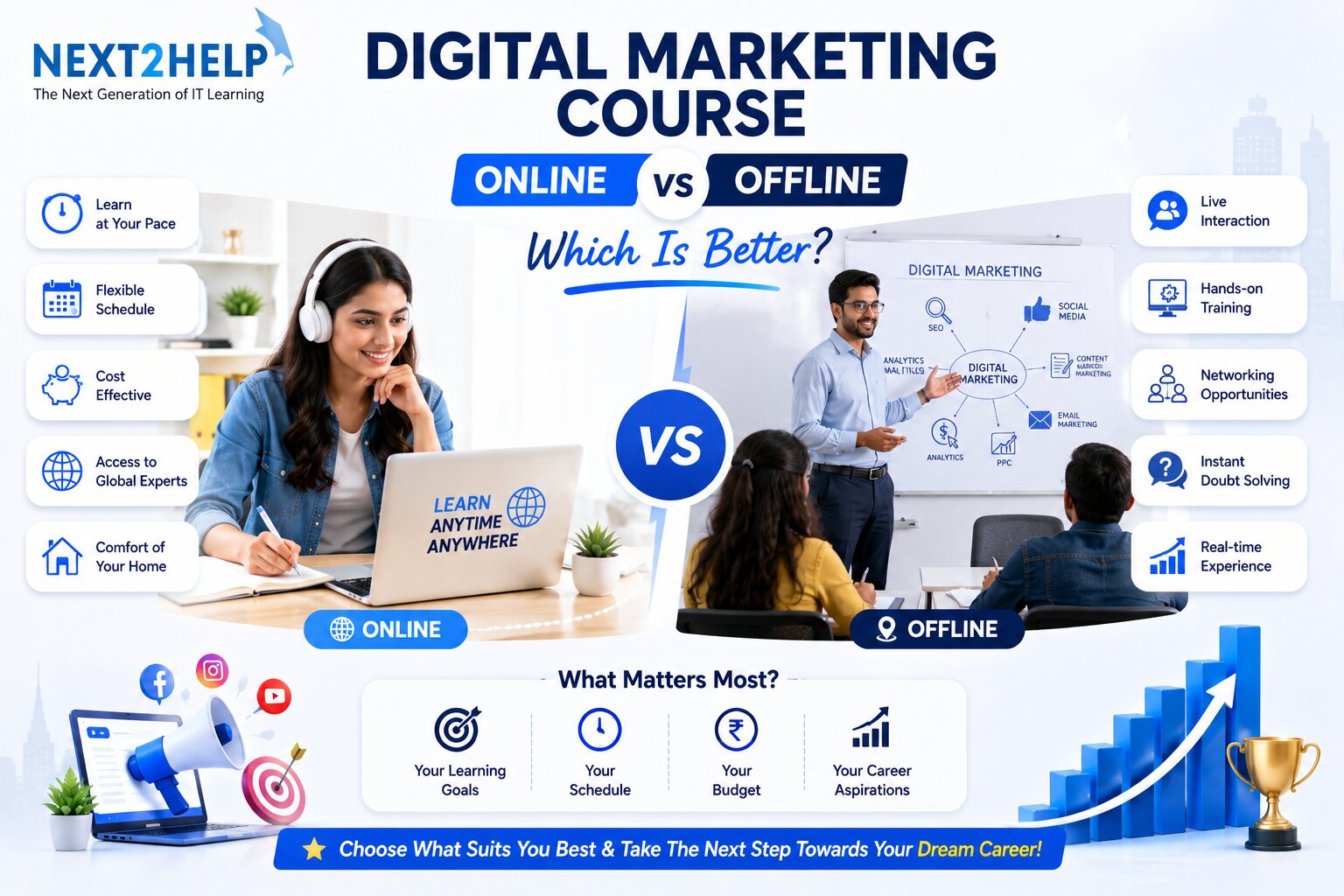
Digital Marketing Course Online vs Offline: Which One Should You Choose in 2026?
Everyone who wants to be a digital marketer has to ask themselves: Should I take a digital marketing course online or in person? Both formats promise the same destination—a thriving career in one of the world’s fastest-growing industries but the paths are meaningfully different. Knowing the real trade-offs can save you months of frustration and thousands of rupees worth.
This guide walks you through all the essential points to help you make an informed, confident choice.
What Is a Digital Marketing Course Online?
An online digital marketing course is delivered through a web-based platform — live video sessions, pre-recorded modules, downloadable resources, and virtual mentor support. You learn from anywhere: your bedroom, a cafe, or during a commute. Most programs offer lifetime LMS access so you can revisit every lesson long after the course ends.
Key advantages of an online digital marketing course include full schedule flexibility, lower fees (no campus overheads), access to global instructors, and the ability to build comfort with digital tools from day one — which is exactly what employers expect.
What Is an Offline Digital Marketing Course?
An offline digital marketing course takes place inside a physical classroom. You attend at fixed times, interact face-to-face with instructors, ask questions in real time, and network with batchmates sitting next to you. The structure is externally imposed, which many learners find motivating.
Digital Marketing Course Online vs Offline: Side-by-Side Comparison
Cost and Affordability
Online courses are almost always more affordable. Institutes save on rent, utilities, and on-site staff — and pass those savings to students. Offline institutes price in real estate, lab equipment, and physical resources. If budget is a deciding factor, online wins clearly.
Flexibility and Convenience
The core advantage of a digital marketing course online is learning on your terms. Working professionals can study at 11 PM; students can pause and rewind lectures. Offline classes demand physical presence at fixed hours — a real barrier if you hold a job or live far from the institute.
Learning Experience and Practical Training
Offline training shines when it comes to hands-on supervision — your instructor can watch your screen, correct live campaigns, and demonstrate tool usage in real time. Online courses compensate with recorded demonstrations, recorded reviews of student projects, and 1:1 doubt-clearing sessions via chat or video call. Premium online programs now match offline quality closely in this area.
Networking Opportunities
In-person networking remains one of offline learning's strongest arguments. Daily interactions build organic professional relationships that often convert into job referrals. Online programs have community forums, Slack groups, and alumni networks — valuable, though harder to replicate the spontaneity of a classroom conversation.
Certification Value
Both formats issue a digital marketing certification on completion. What matters to employers is the institution's reputation and the skills you can demonstrate — not whether you sat in a classroom or in front of a webcam. A reputable online certification from a known brand carries as much weight as an offline one.
Self-Discipline and Motivation
One honest disadvantage of an online digital marketing course is the dropout risk. Without fixed classes and peer accountability, self-motivation becomes the engine of progress. Offline structure removes that burden. Assess yourself honestly: are you self-directed, or do you need external accountability to stay consistent?
Who Should Choose an Online Digital Marketing Course?
Choose online if you are a working professional juggling a full-time job, a student with an irregular timetable, someone living outside a major city, a budget-conscious learner, or a person who prefers self-paced study. The online format suits anyone who is comfortable with digital environments and can hold themselves accountable.
Who Should Choose an Offline Digital Marketing Course?
Choose offline if you thrive in structured environments, prefer immediate face-to-face feedback, want to build a strong local professional network, or simply learn better in a group setting with fixed class hours. If you live near a reputable training centre and can commit to a fixed schedule, offline learning leverages those advantages fully.
Hybrid Learning: The Best of Both Worlds
Many institutes now offer hybrid models — online weekday content combined with weekend offline workshops. This format preserves flexibility while delivering in-person interaction and hands-on sessions. If a hybrid option is available in your city, it is often the strongest overall choice for most learners.
Final Verdict: Digital Marketing Course Online or Offline?
There is no universally correct answer. The right format depends entirely on your learning style, schedule, location, and budget. What is non-negotiable is this: the quality of the curriculum, the credibility of the institute, and your own commitment matter far more than whether the classroom has four walls or a screen.
Choose online: flexibility, lower cost, self-paced progress.
Choose offline: structure, local networking, live mentorship.
Frequently Asked Questions (FAQs)
Is an online digital marketing course valid for jobs?
Yes. Most employers evaluate your skills and the institute's reputation, not the delivery format. A certification from a recognised online programme holds significant value in the job market.
Which is cheaper — online or offline digital marketing classes?
Online courses are generally more affordable because institutes save on physical infrastructure costs. Additionally, students save on commuting, accommodation, and printed materials.
Can I get placement support from an online digital marketing course?
Yes. Reputable institutes offering online courses provide placement assistance, resume building, mock interviews, and access to a partner company network — just as offline institutes do.
How long does a digital marketing course take online vs offline?
Most structured programmes — online or offline — run between 3 and 6 months. Online courses may allow faster completion if you dedicate more hours per day, while offline courses follow a fixed calendar.
Start Your Journey with Next2Help — AI Digital Marketing Course in Noida
Next2Help is the name to know for an industry-ready, AI-driven digital marketing course in Noida. Students learn SEO, SEM, Social Media Marketing, PPC, Content Strategy, Email Marketing, and hands-on AI tools like ChatGPT and Google Bard - all designed to make them job-ready.
It's easy to learn offline with Next2Help since it offers a variety of offline options. Next2Help offers instructors with real-world experience, real-world projects, a recognised digital marketing certification, and dedicated placement support.
Next2Help's
AI digital marketing course in Noida
is structured to deliver measurable results for students, working professionals, entrepreneurs, and career switchers alike.

Categories
Recent posts


Best Institute for a Digital Marketing ...
8 Jul 2024
Unlock Your Future with Next2Help Best ...
8 Jul 2024
is react native worth learning in 2026
17 Mar 2026