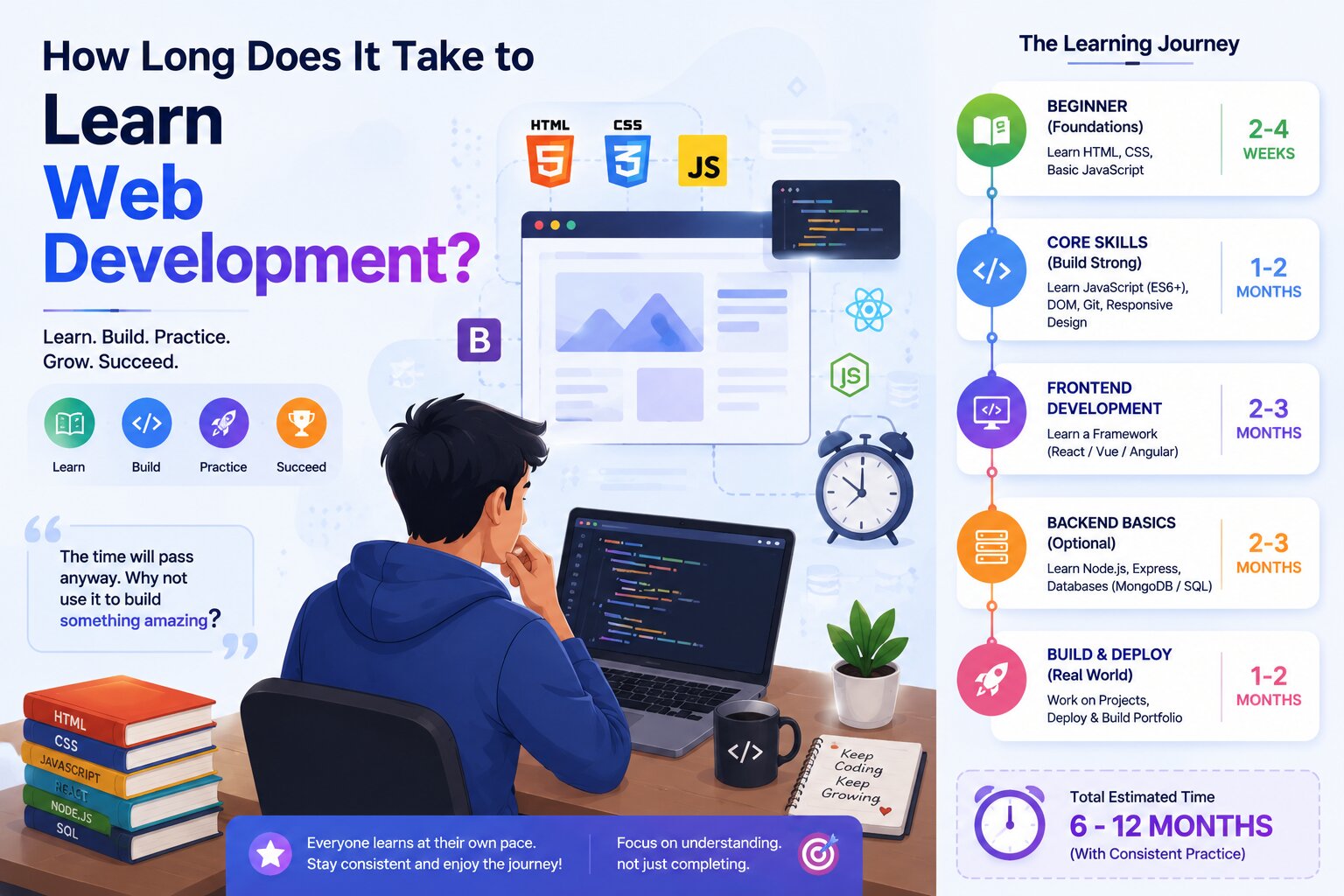
Learning web development takes
3 to 12 months to reach a job-ready level, depending on how much time you
dedicate daily. With 1-2 hours a day, expect 12 months. With 4-6 hours a day
(like a bootcamp), you can get there in 3-6 months. Complete mastery takes 1-2
years of real-world practice.
The real answer depends on 3
things:
- How
many hours per day you practice
- Whether
you build real projects
-
Your consistency over time
The Learning Timeline
Stage 1: Learn the Basics (1 - 3 Months)
At this stage you focus on HTML,
CSS, and the fundamentals of JavaScript. By the end of month 3, you can build
simple static pages and understand how websites are structured. This is the
foundation everything else is built on.
What you learn:
- HTML
structure and semantic elements
- CSS
styling, layouts (Flexbox, Grid)
-
Basic JavaScript: variables, loops, functions
Stage 2: Build Real Projects (3 - 6 Months)
Now you go deeper into
JavaScript and pick up a frontend framework like React or Vue. You start
working with APIs, handling data, and building projects that look and feel like
real applications. Your portfolio begins to take shape here.
What you learn:
- JavaScript
in depth (DOM, async, ES6+)
- A
frontend framework: React, Vue, or Angular
- Consuming
REST APIs
-
Version control with Git and GitHub
Stage 3: Job-Ready (6 - 12 Months)
This is where most people become
employable as junior developers. You understand full-stack basics, can deploy
applications, and have a portfolio of real projects to show employers. You are
comfortable solving problems independently.
What you learn:
- Backend
basics: Node.js, databases (SQL/NoSQL)
- Deployment:
hosting, CI/CD basics
- Responsive
design and accessibility
-
Problem solving and debugging skills
Stage 4: Professional Level (1 - 2 Years)
After 1 to 2 years of consistent
practice and ideally real work experience, you develop the deeper skills that
separate junior from mid-level developers. You think about performance,
architecture, security, and code quality.
What you gain:
- System
design and scalability thinking
- Performance
optimisation
- Security
best practices
-
Mentoring others and code reviews
Quick Reference: Timeline at a Glance
Stage | Timeframe | Outcome |
Learn the basics | 1 - 3 months | Build simple static web |
Build projects | 3 - 6 months | Portfolio-worthy apps with |
Job-ready | 6 - 12 months | Ready for a junior |
Professional | 1 - 2 years | Comfortable with complex, |
The Fastest Path: One Key Rule
Skip tutorials-only mode. Build
actual projects as early as month 2. That is what accelerates learning more
than anything else. The people who get stuck are the ones who watch videos
without writing code.
A simple rule of thumb: for
every 1 hour of learning, spend 2 hours building.
Conclusion
There is no shortcut, but there
is a smart path. Stay consistent, build things, and do not try to learn
everything before starting. Most successful developers were job-ready within a
year — and they got there by writing code every single day.

Categories
Recent posts


Best Institute for a Digital Marketing ...
8 Jul 2024
Unlock Your Future with Next2Help Best ...
8 Jul 2024
is react native worth learning in 2026
17 Mar 2026