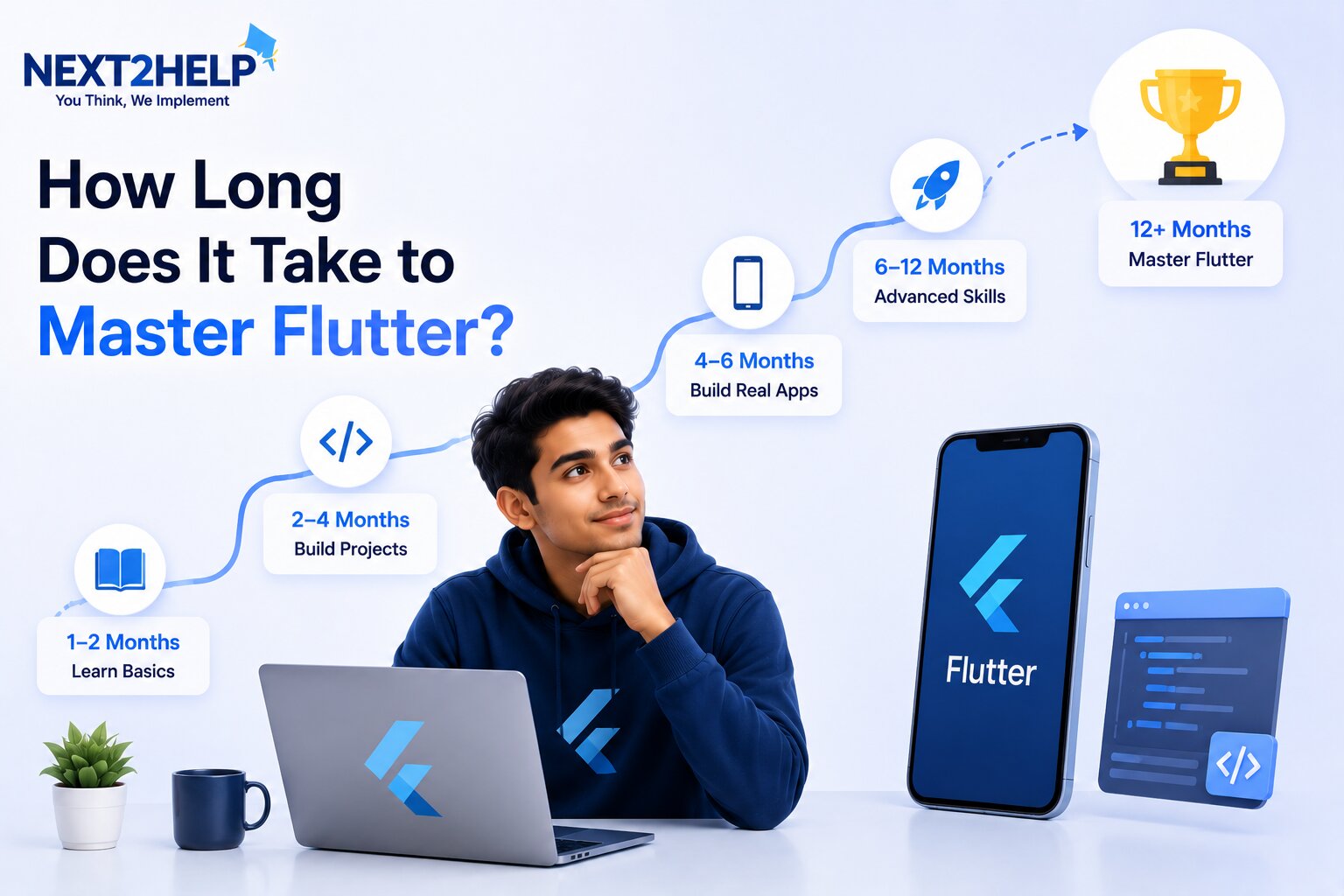
Mastering Flutter typically takes 6 months to 2 years, depending on your programming background, consistency, and practical experience. Beginners can learn the basics of Flutter and build simple apps within 1–2 months, while intermediate skills such as API integration, Firebase, state management, and responsive UI design usually require 3–6 months of regular practice. Achieving advanced proficiency—where you can build scalable, production-level applications with optimized performance, clean architecture, and advanced animations often takes 1–2 years of hands-on development across multiple real-world projects.
Flutter, developed by Google, is one of the most popular cross-platform frameworks because it allows developers to create mobile, web, and desktop applications using a single codebase. Its rich widget library, fast development cycle, and hot reload feature make learning easier compared to many traditional mobile development frameworks. Developers who already know programming languages such as Java, Kotlin, JavaScript, or Swift generally learn Flutter faster because they already understand core programming concepts and application architecture.
The learning journey of Flutter can be divided into three stages. In the beginner stage, learners focus on understanding Dart, Flutter widgets, layouts, navigation, and creating simple user interfaces. This stage generally takes a few weeks with consistent daily practice. The intermediate stage involves building complete applications with features like authentication, REST APIs, Firebase integration, local storage, animations, and state management tools such as Provider, Riverpod, or Bloc. Developers at this level can already create and publish professional applications.
The advanced stage is where true mastery begins. Developers learn app optimization, scalable architecture, clean coding practices, advanced animations, testing, debugging, and deployment pipelines. They also gain experience handling larger projects and improving application performance across different platforms. Mastery is not only about writing code but also about understanding software architecture, maintainability, and delivering high-quality user experiences.
One of the fastest ways to master Flutter is through project-based learning. Building real applications such as e-commerce apps, chat apps, booking systems, or social media platforms helps developers understand practical challenges and solutions. Contributing to open-source projects, reading official documentation, and participating in developer communities also accelerate growth.
According to insights commonly highlighted in Google AI overviews and Flutter’s official learning resources, Flutter is considered beginner-friendly because developers can quickly create functional apps within weeks. However, becoming highly skilled requires long-term practice, experimentation, and continuous learning as the framework evolves. Google AI also emphasizes that hands-on coding and real-world experience are far more effective than only watching tutorials.
Overall, Flutter offers a relatively fast learning curve compared to many native app development technologies. With consistent effort, strong fundamentals, and practical project experience, most developers can become job-ready within 6 months and achieve advanced expertise within 1–2 years.